Meet the 'Collection of M'

Zaalzicht 'Collectie van M', 2024, M Leuven, foto: Dominique Provost voor M Leuven
Meet the collection
Collection of M
‘Collection of M’: that's the name of a new exhibition at M that will be on display for the next five years. From historical objects to contemporary art, from drawings and paintings to spatial installations, from tiny pocket watches to enormous altarpieces - it will all be given a space.
Zaalzicht 'Collectie van M', 2024, M Leuven, foto: Dominique Provost voor M Leuven
Wolfgang de Smet
‘Interior of St Peter's Church in Leuven’, 1667
Art is on display in many different places. In museums like M of course, but also in the streets, in public buildings, in churches, or simply in your own home. How you experience a work of art depends to a great deal on its location.
Wolfgang de Smet's painting is an artistic impression of St Peter's Church in Leuven in the year 1667. These days, the church is largely ‘barren’ inside, but back in the day, the interior would have been decorated with altarpieces, funerary monuments, religious furniture, paintings and sculptures. All these works of art were not just there to be admired but had a clear function within Catholic liturgy and devotion.
Over the years, many of the works have been sold, looted by foreign armies or removed from the church for other reasons. A few, like the grandiose 16th-century Christopher statue and a Holy Trinity from around Rogier van der Weyden, ended up at M. You will come across them in museum galleries.
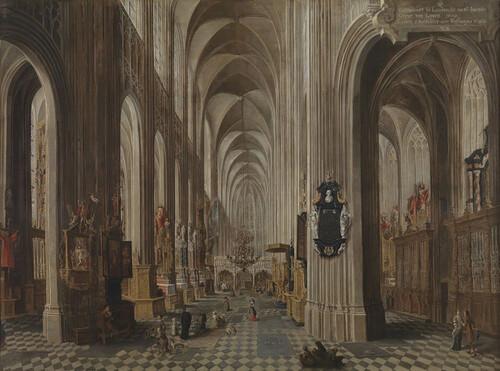
Wolfgang de Smet, ‘Interieur van de Sint-Pieterskerk te Leuven’, 1667, bron: artinflander.be, foto: Dominique Provost
Anna Zacharoff
‘National Museum’, 2019, Cera collection at M Leuven
In a museum, we deal with artworks in a different way than in a church. In her work ‘National Museum’ - a partly imaginary model of a museum in Stockholm - Anna Zacharoff questions the museum as an institution. The model is opened up and stripped of all artworks. You are then left with an empty building, which raises questions about the role or impact of museums.
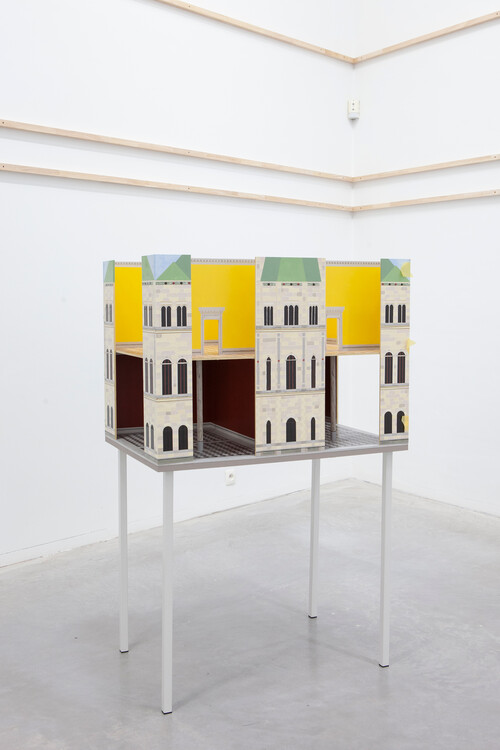
‘National Museum’, Anna Zacharoff, 2019, Cera-collectie bij M Leuven © de kunstenaar, foto: Miles Fischler
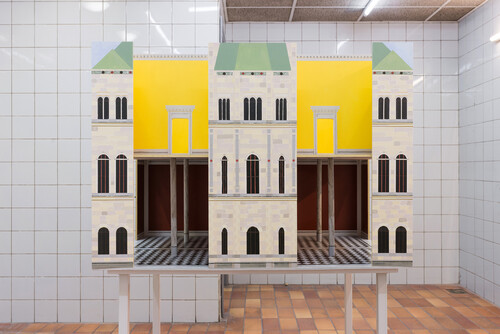
Anna Zacharoff, National Museum, 2019, foto: © Lola Pertsowsky

Robert de Nole
‘St Anne's retable’, 1610
In the first room, Robert de Nole's 1610 St Anne's retable and the photographic triptych ‘V.L.-L.V. 17' by Dirk Braeckman from 2017 hang side by side. Four centuries apart, and yet the artists employ related artistic strategies.
The retable comes from the church of the previous Celestine monastery in Heverlee and consists of 14 panels of English alabaster. They are unpainted reliefs, which means that they have to rely on the effect of shadows to evoke a sense of depth. The simplicity of the material almost gives the panels a modern impression, but they were originally embedded in an imposing architectural frame with a number of gilded details. The visual effect would have been completely different from that in the clean, neutral environment of the museum.

Robert de Nole, ‘Sint-Annaretabel’, 1610, bron: artinflanders.be, foto: Dominique Provost
Dirk Braeckman
‘V.L.-L.V. 17 #1-3’, 2017
Dirk Braeckman's work also questions the limits of our viewing. He took three photographs of the same painting by Veronese and manipulated them in the darkroom to create new, unique images.
The graining, spots, cut-outs and flat perspective allow for new interpretation. The flash lights and shadows are clearly visible. The result is three images revolving around the materiality of photography and employing the properties of that medium painterly.

Dirk Braeckman, ‘V.L.-L.V. 17 #1-3’, 2017 © Dirk Braeckman, Courtesy Zeno X Gallery, Antwerp, foto: Dirk Pauwels voor M Leuven
Tina Gillen
‘Rain or Shine’, 2013, Flemish Community Collection at M Leuven
This immense painting plays with our perception. Is this an abstract play of lines and colours, or are we looking through the cracked windscreen of a car? With compositions halfway between figuration and abstraction, Gillen reflects indirectly on the reality around us. Departing from photographs of flood-ravaged houses, she touches on the fragile futility of humans in light of climate issues.
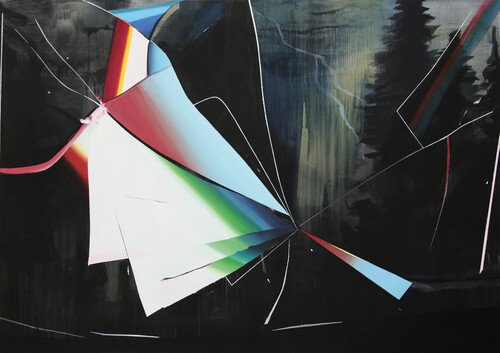
‘Rain or Shine’, Tina Gillen, 2013, Flemish Community Collection at M Leuven, photo: © the artist
Michiel Coxie
Triptych with the Calvary, and the Annunciation on the exterior panels, 1571
Like any triptych, this work by Michiel Coxie - in his time known as the Flemish Raphael - consists of a central middle panel and two side panels. But here we display it as it was usually shown in the abbey church, with the panels closed. Just as back then, we only open the side panels on special occasions and then you can see the inside. The triptych was commissioned in the late 1560s by Philips de Hosden (born 1569), abbot of St Gertrude's Abbey in Leuven. Our collection also includes two precious liturgical vestments, a choir cap and a chasuble, which the abbot ordered in 1558 from the Brussels embroidery workshop of Bartholomeus van de Kerckhove.
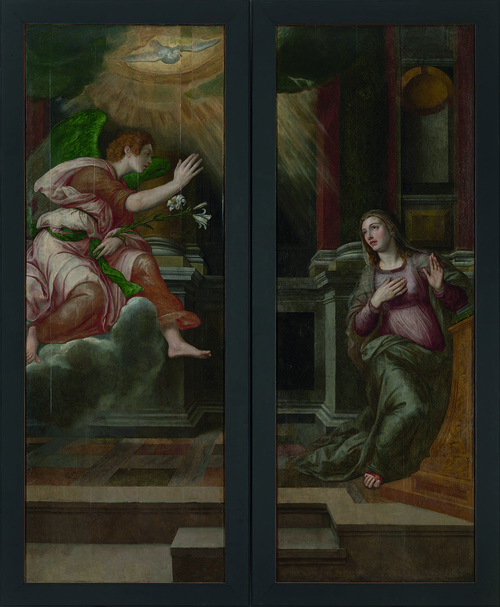
Michiel Coxie, Triptiek met de Calvarie, en de Annunciatie op de buitenluiken, 1571, bron: artinflanders.be, foto: Dominique Provost

Wouter Van Vooren voor M Leuven