Persis Bekkering in conversation with Ellen Dhondt

© Elias Derboven voor M Leuven
Persis Bekkering in conversation with Ellen Dhondt
THE NORMATIVE MESSAGE OF DRESS-UP DOLLS
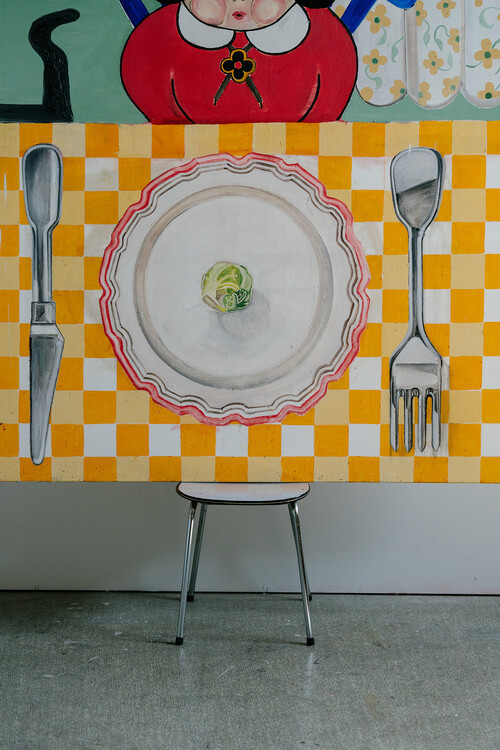
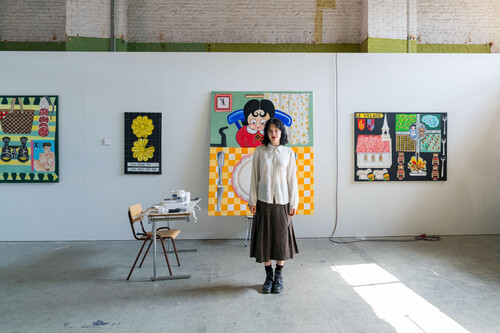
In the middle of the studio, where Ellen Dhondt (b. 2000) is spending five months as M’s artist in residence, a colourful, symmetrical canvas draws the eye. It is bisected by a horizontal line. In the upper half of the work, Ellie Dolly – a cartoon-like, black-haired girl who regularly appears in Dhondt’s work – peeks out from above the table. A solitary sprout on a large dinner plate, sitting on an old-fashioned chequered tablecloth, fills the lower half.

© Elias Derboven voor M Leuven
“I’ve always referred to Ellie Dolly as my alter ego,” says Dhondt, “but I’ve only just realized that Ellie might be too close to me to truly be an alter ego. Because we’re one and the same person. Ellie Dolly is my way of bringing autofiction into my work. She’s a tragicomic figure who appears in all kinds of situations – life simply happens to her.”
Leuven’s Cas-co studio contains numerous other food-related paintings. Even without Ellie Dolly, these also relate to the artist. To the left of the aforementioned work hangs a smaller canvas. On it, Dhondt has painted a compartmentalized plate, of the kind used by children. Dhondt: “I’m fascinated by those divided plates. I’m a very fussy eater; there’s a lot of food that I don’t like – it’s not easy to invite me to a meal in company. But I’m just as pernickety in other areas of life, such as with sound. I find it hellish to be on a train when someone’s on the phone, someone else is playing music, and two people are chatting. I need order.”
The studio looks quite neat, although Dhondt assures us that she tidied up before our visit. Her paintings cover the walls. Some are still wet, while others predate her M-residency. She often receives visitors here, such as fellow artists or curators. In addition to being a place where she can paint undisturbed, the residency also gives Dhondt the opportunity to show her work and discuss it with experienced art world professionals.

© Elias Derboven voor M Leuven
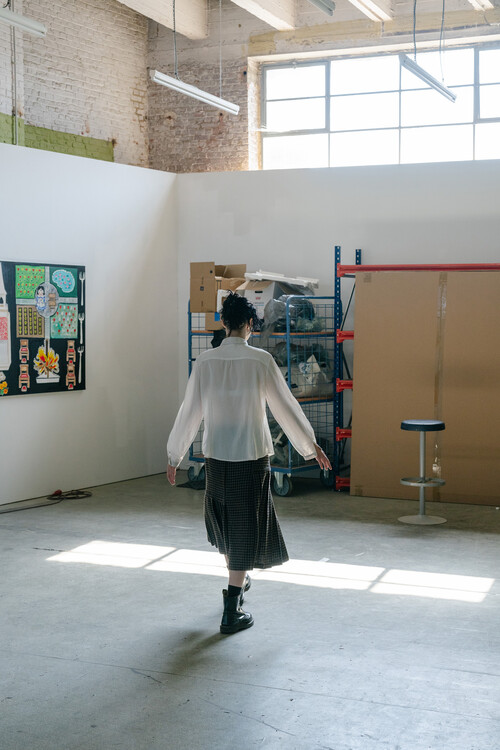
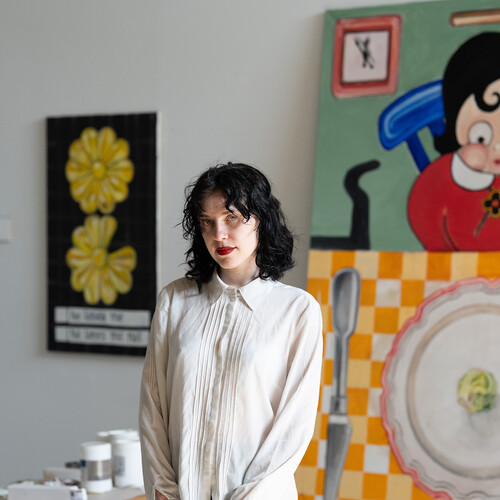
Ellen Dhondt, who grew up in the Kempen region and graduated from KASK in Ghent two years ago, walks enthusiastically along the walls in a long dress with a dab of paint on her cheek. At last, she can devote the majority of her time to painting – a long-cherished wish, she says. Her work is figurative and typically composed on a flat plane. But she also wants to experiment with perspective during her residency. An ambition that has resulted in a work depicting a box of hair dye, creating a three-dimensional illusion. Painted realistically, a woman with wavy black hair gazes sultrily at us from the packaging, while the background and applicator brush remain familiar and flat. “I always dye my hair black; this is what inspired the painting. You can change your entire appearance for just 6€, which I find fascinating.”
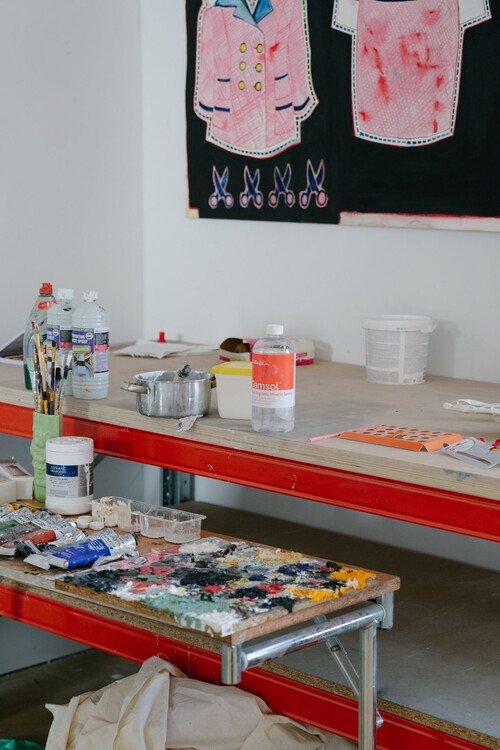
Going forwards, Dhondt isn’t sure whether she’ll paint more three-dimensional looking objects. It feels like a big step. She describes the importance of maintaining constants in her work. In addition to flat compositions, other recurring themes in Dhondt’s practice are seemingly light-hearted, everyday subjects that reveal a darker side when you scrutinize the work. For example, one painting shows pink clothing – a jacket and a skirt – against a black background. The garments are painted as if they could be cut out and used to dress a paper doll: the pieces have edges for folding, while scissors indicate cutting lines. Yet the pink Chanel suit is bloodstained. Dhondt: “This is the outfit that Jackie Kennedy wore when her husband John F. Kennedy was assassinated. She demonstratively wore the suit the entire day.”
Dress-up dolls and clothes are another constant feature in the studio. The artist has long been captivated by educational worksheets. “It’s interesting that you can dress a character and choose the clothes yourself and that all options remain open. Who is the doll without those clothes? Does she still have characteristics? We often define ourselves by our attire, our job, or in relation to the person we marry. These are things that people tend to mention when asked to describe themselves in a few words. But to what extent does that truly define us? I’m interested in these kinds of questions. I’m also fascinated by the two-dimensionality of the dress-up dolls because, in that respect, they resemble paintings.”
© Elias Derboven voor M Leuven

© Elias Derboven voor M Leuven

© Elias Derboven voor M Leuven

© Elias Derboven for M Leuven

© Elias Derboven voor M Leuven
However, a painting is normally something passive, something to look at. Dhondt is also intrigued by the calls to action on the educational worksheets. Take the scissors, which imply ‘cut this out’. “Perhaps it conveys a different way of looking at things, because it demands action.”
One of the new paintings shows a colourless Ellie Dolly beneath a text that reads: ‘Ellie Dolly’s coat is yellow’; a reference to another kind of educational worksheet: the colouring exercise. “We see a colourless coat but immediately think that it’s yellow. The instruction over the drawing thus becomes a truth. There’s no scope for independent thought. To me, that’s both funny and exciting, but also quite problematic. It’s easy to adopt all kinds of normative ideas from supposedly educational exercises.”
This is Dhondt’s work in a nutshell: innocent at first glance, with cheerful, pale colours and cartoon-like images. But the longer you look, the more uneasy you start to feel. A small canvas depicting an old-fashioned potato-masher hangs near the entrance to the studio. It’s only after prolonged observation that you notice the kitchen utensil’s direct and confrontational framing. It resembles a murder weapon.
Is mashed potato another one of her dislikes? “Of course I like it!” she laughs.