Discover the collection

© Elias Derboven voor M Leuven
Discover the collection
Collection of M
Since last June, you’ve had the opportunity to explore the 'Collection of M', a captivating and diverse display of museum artefacts. This collection will be on display until 2029, but there are also changing sections that you need to be quick to visit, such as our regularly updated selection of drawings. Due to the sensitivity of these artworks to light exposure, they are returned to storage after six months to protect them from damage.
© Elias Derboven voor M Leuven
Isaac Israels
The Amsterdam-based artist Isaac Israëls (1865–1934) created this delicate charcoal and pastel sketch of a young woman at her toilette. He signed it in the bottom right-hand corner. The girl is depicted in profile, with what is probably a maid behind her. She uses a small hand mirror to apply makeup to her eyes. She wears a bodice and a skirt as undergarments, with her arms and shoulders exposed, and her hair pinned up. Isaac Israëls was one of the leading Amsterdam Impressionists. These late 19th-century artists were inspired by French Impressionism for their depictions of city life.

Jonge vrouw bij haar opschik, Isaac Israels, zonder datum, Collectie M Leuven, foto: M Leuven
Xavier Mellery
A woman in a dark cloak sits on a chair behind a balustrade with her back to the viewer. She is looking ahead, towards Leuven Town Hall. According to the signature, Xavier Mellery (1845-1921) completed this drawing in Leuven in 1916. Two years earlier, a large part of the city centre had been reduced to rubble by the German occupiers, but the town hall had remained intact. Perhaps this is why Mellery depicts the town hall from a relatively low vantage point. This staging hides the war damage and gives the scene a surreal, melancholy feel. Mellery, who lived and worked in Brussels, donated the drawing as a tombola prize for the 1916 festivities organized at Saint Gertrude’s Abbey by two charitable organizations. Since the winner failed to claim the prize, the organizers donated it to the city of Leuven as a keepsake.
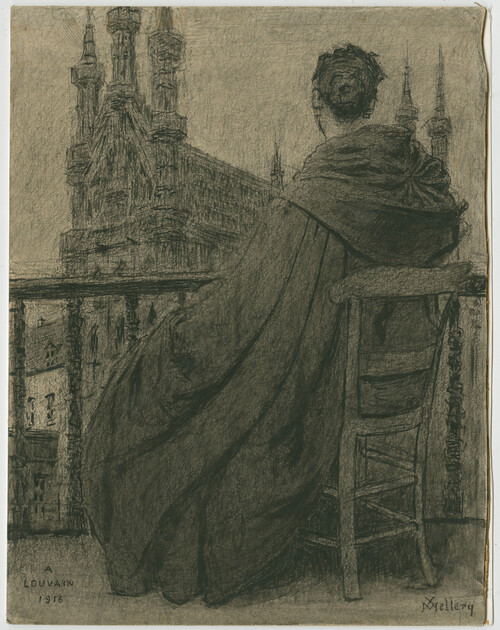
Zittende volksvrouw op een balkon, kijkend naar het stadhuis van Leuven, Xavier Mellery, 1916, Collectie M Leuven, foto: M Leuven
Aleksandra Chaushova
Reality and fiction are never far apart in the highly detailed pencil and pastel drawings of Aleksandra Chaushova (1985). She depicts humans, animals, and objects with exceptional realism. However, due to her alienating staging and figures, she conveys deeper emotional, biographical, and narrative layers. ‘Romantic Species’ (2020–2021) is a series of seven drawings in the M-Collection. In them, Chaushova combines meticulously detailed (portraits of) humans, exotic birds, and plants, creating self-portraits that sometimes feature hybrid creatures.

Romantic Species / Protea Pin Cushion, Aleksandra Chaushova, 2020, Collectie Vlaamse Gemeenschap bij M Leuven © de kunstenaar

Romantic Species / Cape Crow, Aleksandra Chaushova, 2020, Collectie Vlaamse Gemeenschap bij M Leuven © de kunstenaar
Pieter-Jozef Verhaghen
Pieter-Jozef Verhaghen (1728–1811) was born in Aarschot, but he lived and worked in Leuven. He had a very successful painting career, which even led him to the Viennese court of Empress Maria Theresa of Austria. His work was rooted in the style of Flemish Baroque masters, particularly Gaspar de Crayer and, most notably, Peter Paul Rubens. This is not only apparent from his paintings, but also from his drawings. This chalk drawing is a study of two male heads at different ages. The young figure at the top, with smooth skin and chubby cheeks, stands in sharp contrast to the older man with a beard and wrinkled face at the bottom. Noteworthy is the detailed depiction, the fine hatching, and the strong contrast between light and shade. Verhaghen probably used an engraving as the basis for his drawing, rather than a live model.

Twee apostelhoofden, Pieter-Jozef Verhaghen, zonder datum, Collectie M Leuven, foto: M Leuven
Els Dietvorst
Visual artist and film-maker Els Dietvorst (b. 1964) combines art with activism, often collaborating with various socio-cultural communities to explore topics such as migration, diversity and the relationship between humans and nature. Her works include videos, sculptures, installations and drawings. Dietvorst moved to Ireland in 2010. There, she continued her practice and incorporated her surroundings into her work. In 2021, she received the Ultima for Visual Arts, a recognition of her lasting impact on the art world. This drawing in bistre (a brownish-yellow pigment) is part of a series of small, untitled drawings. We make out a human figure, whose face gives way to freer expression – an effect that is achieved by setting the ink in motion.

Zonder titel, Els Dietvorst, 1998, Cera-collectie bij M Leuven © de kunstenaar 2025, foto: Johan Geleyns
Jef Geys
Jef Geys (1934-2018) was known for his critical and playful approach to art. He frequently incorporated everyday items in his artistic creations. His works – paintings, photographs, installations and texts – challenged the boundary between art and life, with strong social engagement. He was also known for his unconventional exhibition methods, such as distributing his ideas through home-made regional newspapers. The figures in this drawing, which Geys describes in the caption as ‘godlike figures’, are based on the rock carvings in Tanum, Sweden. This UNESCO World Heritage Site is renowned for its well-preserved Bronze Age rock carvings. They depict representations of daily and cultural life 3000 years ago, and contain many mythical or supernatural humans and animals.
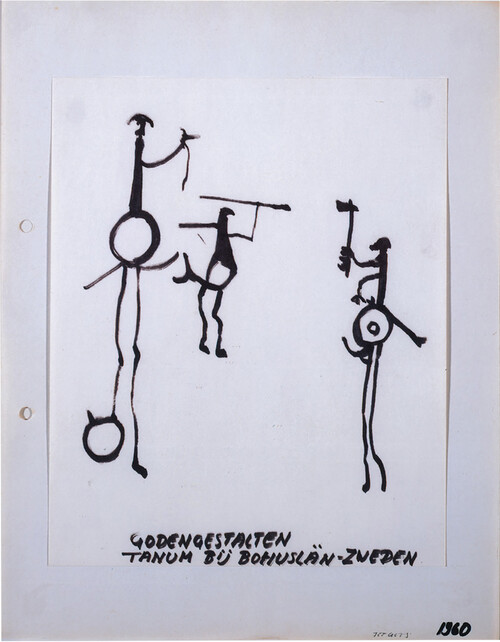
Zonder titel, Jef Geys, 1960, Cera-collectie bij M Leuven © SABAM Belgium 2025, foto: Philippe Debeerst

Wouter Van Vooren voor M Leuven