Saint-Peter's Church: traces of 1,000 years of history
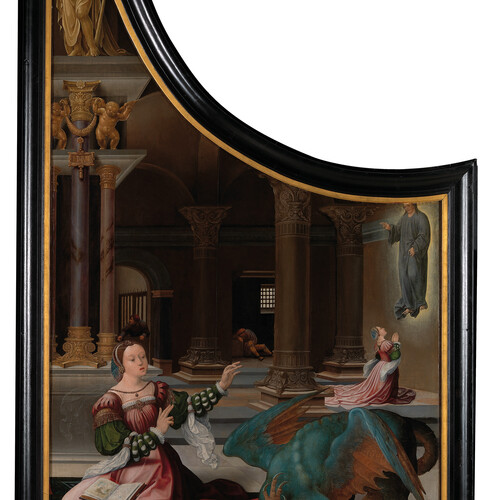
Heilige Margaretha van Antiochië en de draak, Jan Rombouts, ca.1525-1530, Collectie M Leuven, bron: artinflanders.be, foto: Dominique Provost
Saint-Peter's Church: traces of 1,000 years of history
Find the dragon!
St Peter's Church has a long and eventful history. You can see many traces of this around the church itself, but also in M's collection.
Heilige Margaretha van Antiochië en de draak, Jan Rombouts, ca.1525-1530, Collectie M Leuven, bron: artinflanders.be, foto: Dominique Provost
The story begins around the year 1000, Marjan Debaene, chief curator of ancient art, tells us.
‘That's when a church in Romanesque style was built here. All that is left is the choir, which is now the crypt, because the street level was a lot lower back then. It was also where the tomb of Duke Henry I was located, which is now in a side chapel.’
‘The construction of the Gothic church started shortly after 1400. The Romanesque parts were replaced step by step, starting with the east choir. This took about a century which at that time was quite fast. As a result, the church is remarkably homogeneous in style.’
‘By 1500, only the west building was still missing. Joost Massys drew three gigantic towers, but they sank into the swampy ground during construction. That is when they stopped, what is left today is only the base of the towers. But we have a 16th-century model of what it should have looked like in the church.’
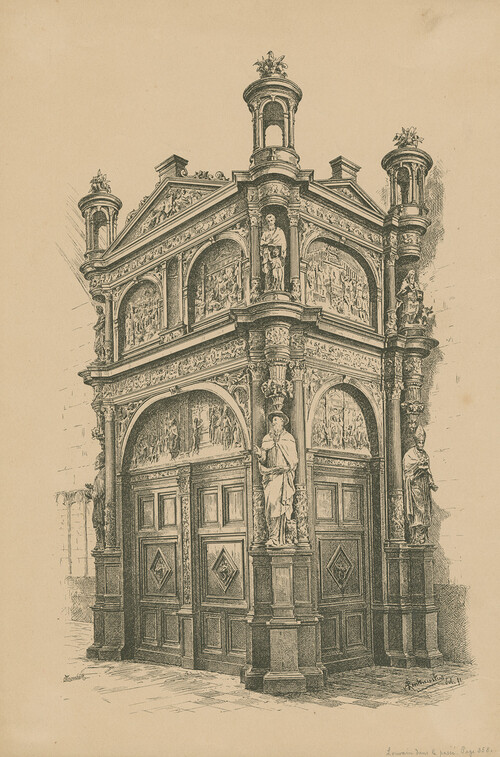
Gravure van het westelijk tochtportaal van de Sint-Pieterskerk in Leuven, A. Rentmeesters, 1891, Collectie M Leuven, foto: M Leuven
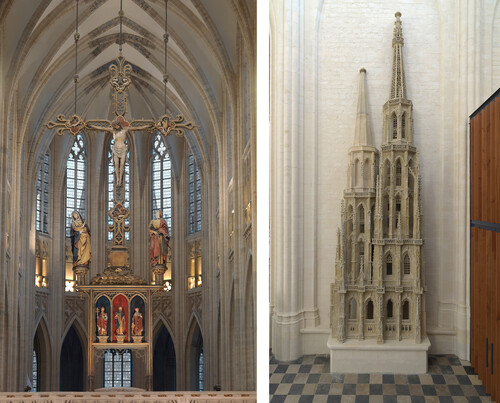
Links: Triomfkruisensemble, Jan II Borman, ca. 1490, Collectie M Leuven Sint-Pieterskerk | Rechts: Maquette voor de westtorens van de Sint-Pieterskerk, Joost Massys en Jan Beyaert, ca.1524-1530, Collectie M Leuven | Sint-Pieterskerk | Bron: artinflanders.be, foto: Dominique Provost
The most beautiful dragon
‘The church has had an eventful history. Much has been destroyed, sold or disappeared. I am currently researching a late-medieval retable that presumably stood on the high altar, of which only a few fragments have survived. These were sold in the 19th century to the Royal Museums of Art and History in Brussels, where they are still on display.’
‘M's collection contains some 250 works and objects from St Peter's Church. Most of it is still in the church itself, but about 40 pieces we keep at M, such as two wings of a retable by Jan Rombouts. If you come to M, be sure to look at the back where Rombouts painted the most beautiful dragon of the entire 16th century. At least if you ask me (laughs).’
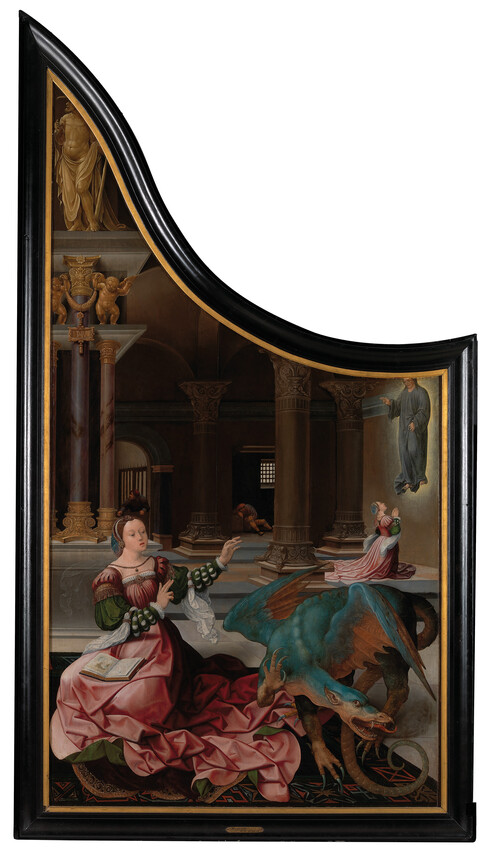
Heilige Margaretha van Antiochië en de draak, Jan Rombouts, ca.1525-1530, Collectie M Leuven, bron: artinflanders.be, foto: Dominique Provost