Souffleur, what's an exemplum iustitiae?

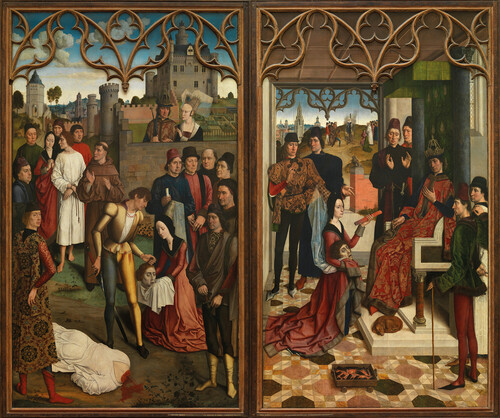
Dieric Bouts, 'The justice of Emperor Otto III: 'The martyrdom of the innocent count & The trial by fire', c. 1473-1475

Dieric Bouts, 'The justice of Emperor Otto III: 'The martyrdom of the innocent count & The trial by fire', c. 1473-1475, Royal Museums of Fine Arts of Belgium, photo: Johan Geleyns
SOUFFLEUR

Exemplum iustitiae

Like all domains, art has its own vocabulary. In 'Souffleur', employees of M explain and give background to professional terms that may sound familiar to you, but of which you may not know, or no longer know, exactly what they mean. 

Dieric Bouts, 'The justice of Emperor Otto III: 'The martyrdom of the innocent count & The trial by fire', c. 1473-1475

Dieric Bouts, 'The justice of Emperor Otto III: 'The martyrdom of the innocent count & The trial by fire', c. 1473-1475, Royal Museums of Fine Arts of Belgium, photo: Johan Geleyns

Wies De Vos, Collaborator education: "An Exemplum iustitiae, or justice scene, is a work – usually a painting – where the subject is justice. You could call it a separate genre and which was particularly popular in the 15th, 16th and 17th centuries. The scenes were made for places where justice was carried out. These were often town halls, courts as we know them today did not exist at that point. They depict stories from the Bible or ancient legends referring to justice. The Last Judgement was a popular theme, but many justice scenes show very specific stories, some of which do not recur anywhere else in art history."


"One of the first examples was a work created by Rogier van der Weyden in 1436 for the Brussels town hall. It depicted justice scenes of the Roman emperor Trajan and the Brussels judge Herkenbald, but was unfortunately lost in 1695 when French troops bombed the city. Van der Weyden's contemporaries had a great admiration for the work. The city council of Leuven, Brussels' great rival, wanted to compete and commissioned Dieric Bouts to create four giant justice scenes for its own town hall. There, the theme was the justice of Emperor Otto III. The latter allegedly condemned his own wife to the stake for giving false testimony against an innocent count, who was then executed. The four paintings were supposed to encourage the Leuven judges, like Emperor Otto, to judge without regard for the individual."

Dieric Bouts, 'The justice of Emperor Otto III: 'The martyrdom of the innocent count & The trial by fire', c. 1473-1475

Dieric Bouts, 'The justice of Emperor Otto III: 'The martyrdom of the innocent count & The trial by fire', c. 1473-1475, Royal Museums of Fine Arts of Belgium, photo: Johan Geleyns

"In fact, Bouts died having only finished two of the four paintings. These are now in the Royal Museums of Fine Arts in Brussels. Two full-size copies from the 19th-century and which the city in 1888 commissioned from the artist Franz Meert (1836-1896), hang in Leuven town hall. These are the only painted justice scenes in the city’s collection. But in collections at the City Hall and at M contain sculpted scenes that also refer to justice and jurisprudence."
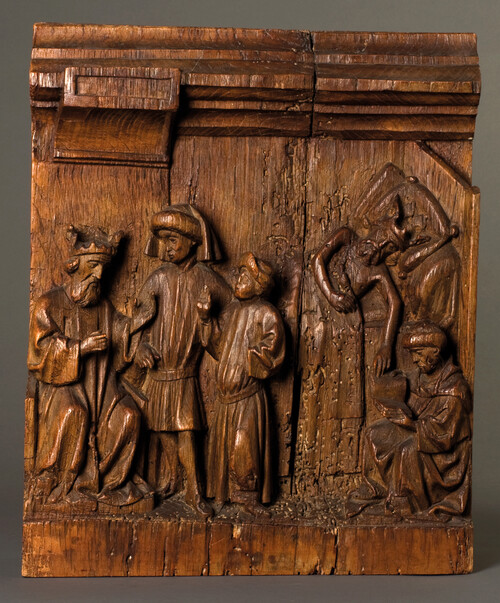
Willem Ards, ‘Droom van Koning Nebukadnessar’, ca. 1448-1449, M Leuven

Willem Ards, ‘Droom van Koning Nebukadnessar’, ca. 1448-1449, M Leuven