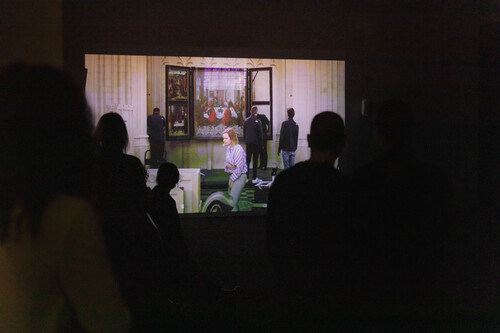
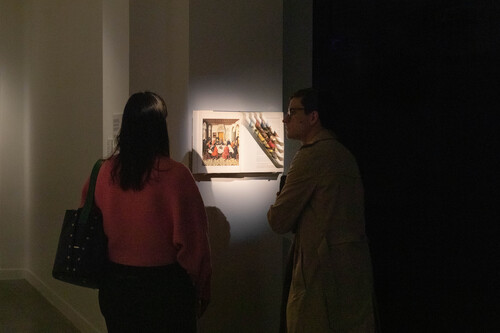
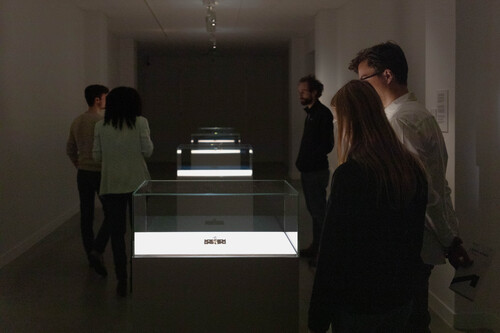
M presents the first Belgian solo exhibition of American artist Jill Magid. The exhibition follows the movements and resonances of one of Leuven’s most iconic art works – ‘The Last Supper’ by Dieric Bouts – through a multimedia installation.
Jill Magid (USA, 1973) lives and works in Brooklyn, New York.
She has exhibited her work in solo exhibitions at museums and institutions including the Tate Modern (UK), Whitney Museum (USA), The Modern Art Museum Fort Worth (USA), Museo Universitario Arte Contemporáneo (Mexico), The Renaissance Society (USA), Magasin III Museum of Contemporary Art (Sweden), and the General Intelligence and Security Service of the Netherlands.
Magid is a recent awardee of the Solomon R. Guggenheim Fellowship and VIA Art Fund, and The Calder Prize. Her award-winning feature film ‘The Proposal’ (2018) premiered at Tribeca Film Festival and was released in theaters internationally.
Her work is in the collections of the Centre Pompidou, Whitney Museum, Fundacion Jumex, Walker Art Center, and the United States Mint, among others.
‘The Migration of the Wings’ is a visual and sonic meditation on the forced migration of the triptych ‘The Last Supper’ (1464-1468) by Dieric Bouts, which was dismembered in 1707 and stripped of its wings. Throughout the painting’s history, the wings, depicting scenes of Jewish diaspora from the Old Testament, have been repeatedly stolen, exploited as commodities, used as political tools of negotiation and as reparations of war. Meanwhile, the central panel, which shows a nearly still scene from the New Testament, has remained at Saint Peter’s Church in Leuven.
Jill Magid evokes the cyclical movement of the wings through sculptures and a two-channel film that enters the interior spaces where the wings traveled. In the 19th Century, the panels were split between the Alte Pinakothek in Munich, and the Bode Museum in Berlin. In 1919, as stipulated in The Treaty of Versailles, they were returned to Leuven only to be forcibly removed by the Nazis in 1942. They were then buried in the salt mines of Austria until 1945, when they were recovered by American soldiers and returned to Leuven, where they remain today, hinged to the central panel.
As in much of Magid’s practice, this new body of work intimately questions how objects can be deployed as political pawns, and how these objects come to contain the traces of violence that resonate throughout history – if we listen.
Curator: Valerie Verhack
During your visit
Ready to visit M? All the texts and audio that you can use during your visit can also be consulted digitally.
Een maandelijkse update van wat er in M te beleven valt?
Op de hoogte blijven van alle initiatieven, activiteiten en tentoonstellingen van M? Schrijf je hieronder in op de nieuwsbrief en dan zorgen wij op onze beurt voor jouw maandelijkse portie nieuws van M.