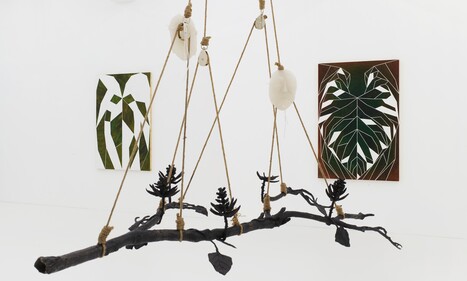
Julie Cafmeyer interviews Els Nouwen

© Josefien Tondeleir voor M Leuven
Julie Cafmeyer interviews Els Nouwen
"I'm drawn to the night"
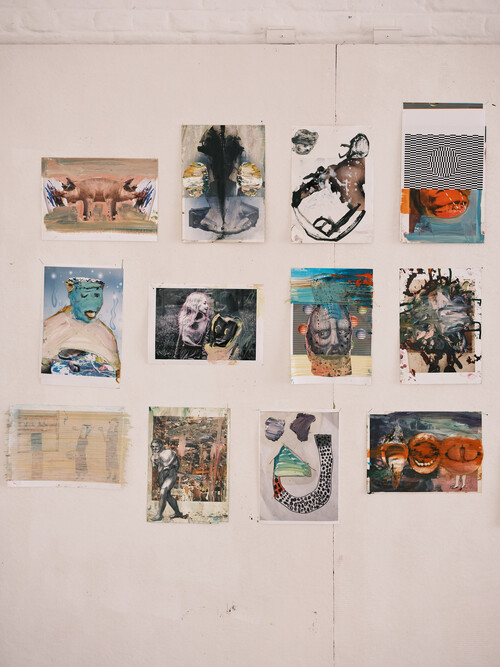
“For fifteen years, I threw away everything I made,” says artist Els Nouwen. I am in her Antwerp studio. On the wall are images she has collected over the years from magazines, second-hand books, and the internet. She is fascinated by darkness, suffering, the absurd, and the grotesque: skulls, Magritte painting a naked woman into thin air, the severed head of Holofernes, a scarecrow shaped like a female head, and a Hindu god. “I’m drawn to the night,” she says. “I try to bridge contradictions: the gruesome and the sacred, the erotic and the repulsive.”
© Josefien Tondeleir voor M Leuven
Montage, cut and paste, assemblage
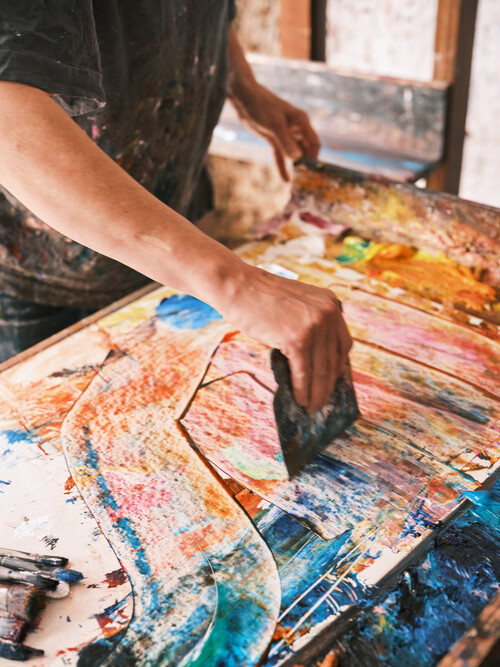
A recurring strategy is to work on several paintings simultaneously. Along the way, things fall into place. It is a practice that must remain in constant motion. She has always felt “a gigantic, intrinsic motivation” to paint. The destruction of an image, even a hundred times over, and the relentless searching is fuelled by a deep inner need. She cites Gerard Reve: “I believe that the truth is only revealed in that which collapses, which disintegrates.”
Does she sometimes regret destroying her work? “Yes,” she admits. “Afterwards I sometimes think: it wasn’t that bad. I actually need an in-between room for work that might have a future, but that’s not something I can force. Certain works are unbearable, and then they have to go – it’s stronger than I am.”
© Josefien Tondeleir voor M Leuven

© Josefien Tondeleir for M Leuven
I look at a painting of the innards of a sheep with a fungal infection. “You’re so lovely, but you make such gruesome work,” one of her students once told her. And that’s true. It can rot; it can gnaw at you. It can hurt, chafe, and repel. And yet something sensual is conjured when I look at a shellfish that might just as well be a vulva. That is the magic of painting: eroticism and nightmare evoked in tandem.
She looks at her work. “So, what do I want to do with it?” she asks herself aloud. “Give my imagination free rein, celebrate the dark gloss of life.” Destruction as an instrument of creation. For Els Nouwen, the true abyss is not to paint.

© Josefien Tondeleir voor M Leuven
© Josefien Tondeleir voor M Leuven

‘Cauliflower Ears XOOOO’ © Kristel Van Ballaer