Behind the scenes of M: team engineering

© Rebecca Fertinel for M Leuven
Behind the scenes of M
team engineering
Provided everything works, you should never encounter the four people from team engineering at work at M. Yet the museum could not run without them. Team coordinator Maarten Janssen explains.
© Rebecca Fertinel for M Leuven

© Rebecca Fertinel for M Leuven
© Eline Willaert for M Leuven
Sponge
Something else special about a museum like M is that the artworks must be kept in the best possible conditions, both in the halls and in the depot.
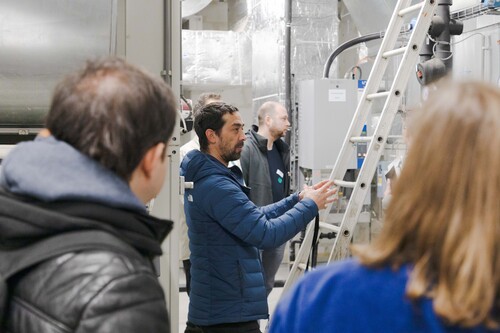
“Yes, everything has to stay within set limits: the temperature, humidity, CO2 levels... These limits are very narrow and you have to be able to guarantee those conditions 24/7. The technical term for that is HVAC, heating, ventilation and air conditioning. We have hundreds of measuring points around the site and if a limit is exceeded at any point, we are notified via our mobile phone. Then we have to act at once. Especially in the Vander Kelen House, a building hundreds of years old and much less well insulated than the rest of the museum. That’s like a sponge.”
“Office buildings also have HVAC systems, but there most people arrive at 9am and leave again at 6am. For us, it is much more complicated. Not only with the artworks, but also because many events take place outside opening hours.”
“On top of that, all our buildings are interconnected which means that the same air circulates throughout the complex. We have 11 air groups, and if one fails in one building, that has an impact everywhere. When there is an event, there are all sorts of issues with boundaries. Say there is a reception in a room for 200 people and it gets a bit too hot. Well, you can’t just turn up the air conditioning, because you will also change the temperature in the room below, and there are works of art there. So people just have to adapt a bit.”
Almost all museums complain about not having enough depot space. I assume M is no different?
“True. We try to use every cubic centimetre of space as efficiently as possible, but even then our depot is overflowing. We’ve had to rearrange the basements a few times. You don’t just need storage space for the objects, you also need a quarantine area for new pieces, a workspace where objects can be checked and registered... Fortunately, the city has just acquired a building in the Hanengang, the street where the Seven Oaks café used to be. It is a large hangar that exits at the back of the museum. We will use that mainly as depot space.”
“We need space for our exhibition furniture too. In the early years, we had a company built that for every exhibition and it was then discarded. Containers full of beautiful material, all for landfill. That clearly was not sustainable. Now we build a lot of things ourselves, and we have learned over time to work with items that you can reuse. We know exactly what we have lying around and how to rearrange it for the next exhibition: a new coat of paint, make it a bit smaller or bigger... You have to be able to store all that material, of course. You need a lot of space for that, but it does bring the production costs for exhibitions down. We used to have more than ten containers of exhibition waste a year, now we have three or four.”
Danish model
You are also investing in renewable energy.
“We are one of the five major consumers of the City of Leuven, as our air conditioning system has to run day and night because of the artworks. In 2016, we installed a cogeneration unit which is a gas-powered heating plant that, at the same time, generates electricity. We also have solar panels, part of a project run by Leuven 2030 (the non-profit organisation that aims to make Leuven climate neutral, ed.). We can cover 7% of our consumption with that. When we did it, it was not cost-effective to add even more panels, but we will re-examine that soon, because technology is constantly changing.”
“We are now toying with the idea of using the Danish model for that new depot in the Hanengang: an enclosure that keeps the climate so stable that you consume no, or almost no, energy. There may be some fluctuations, but very limited. We want to work with the City of Leuven engineers to create something that will stand the test of time and have zero footprint.”
“We are also constantly evaluating how we can make our HVAC even greener. Is perhaps a heat pump an option for us? Or could we set up a mini-heat network with our neighbours at KU Leuven? I would love it if we could make M a testing ground for sustainability ideas like that. We have our expertise, and KU Leuven and companies like imec are nearby so we really are in the right place.”