'The Art Bridge' with Mater Dei
The Art Bridge

Zaalzicht 'Wael Shawky: Dry Culture Wet Culture', 2022, M Leuven © Andy Merregaert voor M Leuven
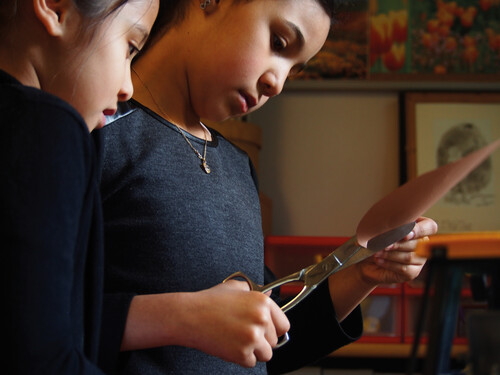
Can art make children more confident? To answer that question, M and the Leuven Mater Dei school in 2016 together launched the 'The Art Bridge' project. Six years later, the school and the museum look back on a successful initiative.

Zaalzicht 'Wael Shawky: Dry Culture Wet Culture', 2022, M Leuven © Andy Merregaert voor M Leuven
Sofie Vermeiren, head of public mediation, remembers how it all started.
"We had for some time been working with Mater Dei, a kindergarten and primary school on Sint-Jacobsplein, and we were wondering how we could make that collaboration stronger. That's how we came up with the idea for a joint project. We applied for a project grant in 2015 and we were able to start in 2016. The project was supposed to run for five years, but because of Covid, it has been extended for another year."
"Mater Dei is located in a diverse neighbourhood and so it is a super-diverse school, with many newcomers and many different languages... The main objective of 'The Art Bridge' was to strengthen the social integration of pupils. For that, you have to make them more confident, you have to empower them. We are strong believers in that art can help do that. Those who take a closer look at art and engage with it learn to be critical, think creatively, collaborate, express themselves, build social skills..."
"We also wanted to make teachers aware of the role art and culture can play in their lessons, and we wanted to involve the children's world. For the parents of these pupils, visiting a museum is often a big step. 'The Art Bridge' wanted to lower that threshold."
An engine for language acquisition
"Mater Dei is strongly committed to musical education and sees it as an engine for language acquisition. As many pupils do not have a good command of Dutch, the teachers for example teach in a very visual way. That, in turn, ties in nicely with what we do here at M. We focus strongly on visual literacy, the ability to read and interpret visual language. That shared vision was the basis for a fruitful collaboration."
"It was Conny Feyaerts, a teacher in the third year, who worked hard for the project at the school. She became a kind of teacher in residence. Once a week she did not have to teach and instead worked at M visiting exhibitions, gathering information, putting together a package for visiting school classes... She passed on that information to her colleagues, who could then come to M with their class being well prepared. It was very importantly that everyone at Mater Dei was behind the initiative. Not only Conny, but also the other teachers and the management. If the rest of the school does not believe in it, you will never get such a massive project off the ground."

© Andy Merregaert voor M Leuven

Zaalzicht 'Wael Shawky: Dry Culture Wet Culture', 2022, M Leuven © Andy Merregaert voor M Leuven

Zaalzicht 'Tussen Hemel en Aarde - Beleef Het Laatste Avondmaal van Bouts', 2022, M Leuven © Andy Merregaert voor M Leuven
Souvenir photos
"All the pupils at the school participated in the project, but each year-group followed a separate programme. The first years had interactive tours and workshops. That way, they were introduced to art, learned to look more closely at images and got creative themselves. They also got a tour from the sixth years."
"The pupils from the second year worked with an artist in residence. For the first two years of the project, that was Evy Raes, a photographer. Together, they took souvenir photos. Many of the pupils have few or no photos, for example because they have had to flee their home countries. Evy and Conny made memories with together with the pupils and then they staged and photographed them. It was really beautiful."
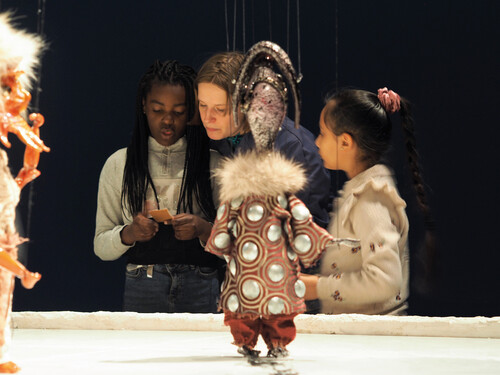
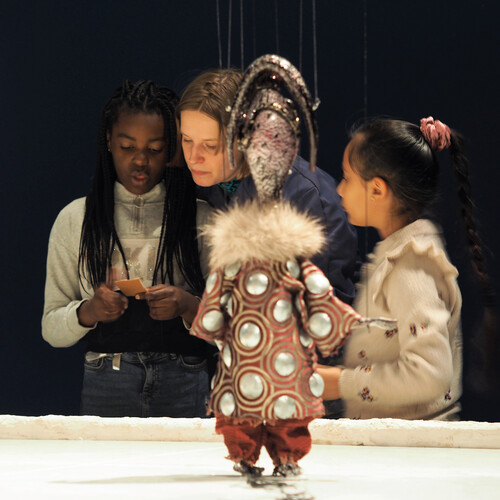
"For the next two years of the project, the pupils did movement and dance exercises together with theatre maker Katrien Oosterlinck, inspired by artworks in M and these exercises were filmed. Initially they had to get used to this, but after a while you could see them becoming more confident. It also benefited their language."
"Covid put the project on pause for a while, but in the 2021-22 school year, we were able to pick up where we left off. We then collaborated with the artist collective Bricol'art with workshops around images and music."
"The fifth and sixth years were given training to be guides. When they had done that, they gave a tour of the museum to their parents, museum staff and pupils from the first year. They were also given an official guide diploma, which was solemnly presented by the director and chair of M, that was something they were very proud of. Some were later asked to work as guides in M. I remember how a secondary school was visiting M at one point and one of the pupils said to the guide: 'I could guide here too, I already have!' So that they had been at Mater Dei (laughs) before."
Scientifically examined
"We were curious to see whether 'The Art Bridge' actually achieved our objectives, which is why we had the project vetted by a researcher from UCLL between 2016 and 2019. Her conclusions were very positive. The children turned out to be very involved and very positive about art. That appreciation grew even more every time they came to M. One of the pupils from the first year said: 'Every time I go back, I like the paintings even more.' The older children reported that the project had made them more confident, certainly an important objective. 'At M it feels like you're a bit older,' said one. 'Like being a leader. That was the first time I felt that in myself.' They hopefully carry that self-esteem with them into the rest of their lives."
What now?
"The project has now ended, but we don't want to let the knowledge gained go to waste. We have put together a publication about the project, and there will also be a poster with steps for other schools and teachers to take. We have also made a film in which we let the pupils of Mater Dei speak, and we certainly remain in close contact with the school. A staff member from M visits three times a year to explain what we do and listen to teachers' ideas or suggestions. I personally thought that was one of the best results of 'The Art Bridge', how we got not only the pupils but also the teachers involved."
"Setting up a similar project with another school is not on the cards at the moment but we have used the experiences with Mater Dei to make our school tours better so that way other schools benefit from this too. Who knows, we might give other Leuven institutions ideas. Perhaps say the library or the theatre could launch an initiative like this? That would be great: if 'The Art Bridge' can inspire others."